
Home › Personal Finance › Snowball Method Excel Template
Previewing: Version 1 · Debt Snowball Planner. Pick another version on the right.
Instant download · No sign-up · No email
Use this free snowball method Excel template to pay off debt in a clear order: smallest balance first, with every freed-up payment rolling into the next debt. Pick the version that fits how you work.
Choose your version
- File
- .xlsx · 219 KB · 2 sheets
- Works with
- Microsoft Excel (.xlsx)
- Macros
- None · formulas only
- Price
- Free
Pay off debt faster with the snowball method
The debt snowball method is a debt payoff strategy. You pay the minimum on every debt, then put every extra dollar on the debt with the smallest balance. When that debt is gone, you add its payment to the next smallest one, so your payment grows like a snowball rolling downhill.
People like it because the first debts disappear quickly, which makes it easier to stay motivated. It works for credit cards, store cards, medical bills, personal loans, auto loans and student loans. The tedious part by hand is the math: which debt is next, how much rolls over and when each balance reaches zero. These snowball debt method spreadsheets calculate it for you.
Best for
- Several debts with different balances
- People who need quick wins to stay motivated
- Credit cards, medical bills, car and student loans
Maybe not for
Anyone who wants to minimize total interest above all else. Version 3 compares your snowball plan with the avalanche method so you can check the difference.
Which version is right for you?
All three are free, formula-driven Excel files built around the snowball method. They are independent, so you can download more than one.
Version 1
Debt Snowball Planner
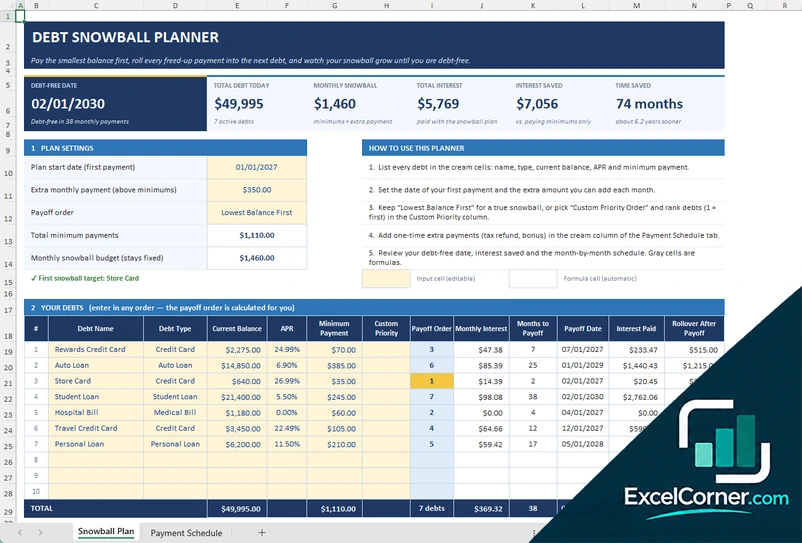
Plan your payoff before you start. List your debts, set an extra monthly payment and see your payoff order, debt-free date and interest saved compared with paying only the minimums.
Snowball PlanPayment Schedule
.xlsx · 219 KB
Version 2
Debt Snowball Tracker
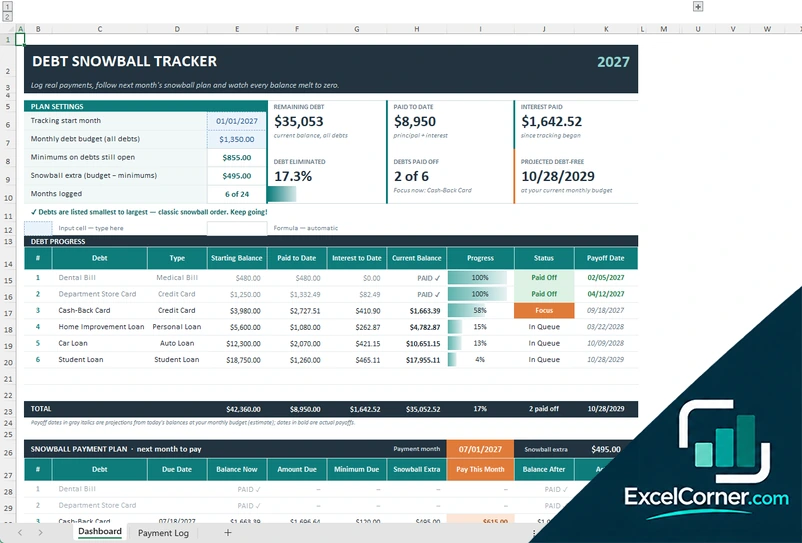
Track your payoff as it happens. Log what you actually pay each month and watch balances, progress and your projected debt-free date update. It also shows which debt gets the extra payment next.
DashboardPayment Log
.xlsx · 32 KB
Version 3
Debt Snowball Dashboard
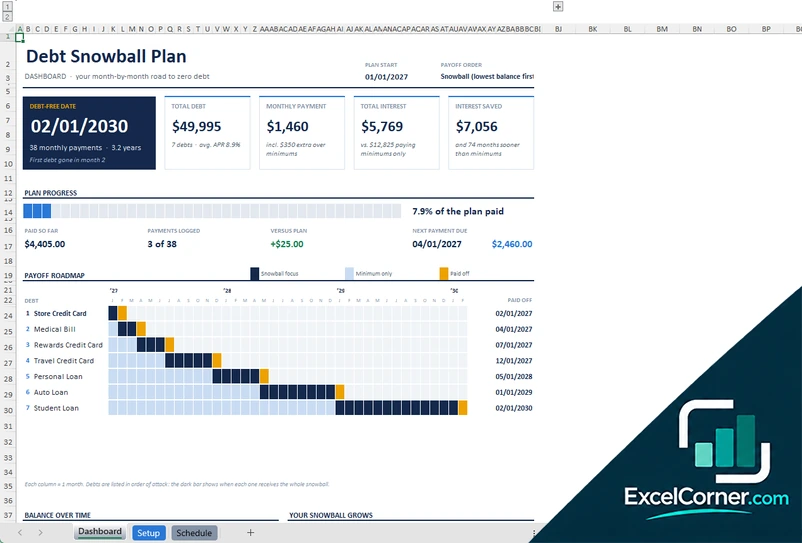
Set it up once on the Setup sheet, then follow a one-page dashboard: debt-free date, plan progress and a payoff roadmap. It also compares your snowball plan with the avalanche method and with minimum payments only.
DashboardSetupSchedule
.xlsx · 397 KB
What is inside the snowball debt method Excel templates
Version 1: Debt Snowball Planner
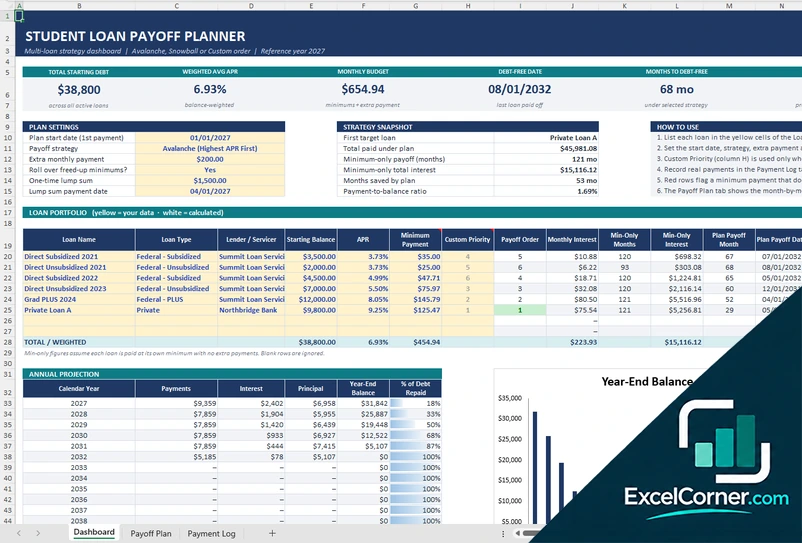
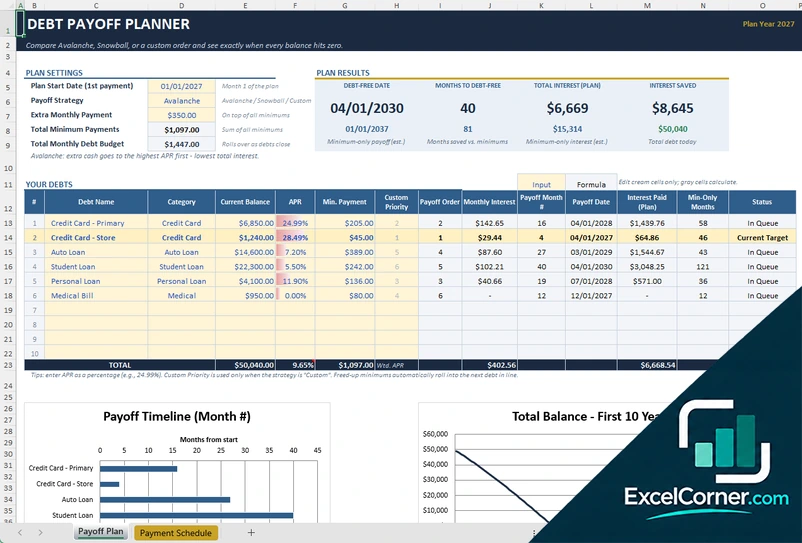
The planner starts with your plan settings: the date of your first payment, the extra amount you can add each month and the payoff order, either lowest balance first or your own custom priority. You list up to 10 debts with their balance, APR and minimum payment, and it shows the payoff date of each debt and the rollover that moves to the next one. It also compares the snowball plan with paying only the minimums (months to debt-free, total interest and total paid) and builds a month-by-month payment schedule with a column for one-time extras such as a tax refund or bonus.
Version 2: Debt Snowball Tracker
The tracker opens on a dashboard with your remaining debt, what you have paid to date, interest paid and how many debts are already paid off. Each debt shows a status of Paid Off, Focus or In Queue with its payoff date, and a snowball payment plan tells you how much to pay on each debt next month, including the extra on your focus debt. You type what you actually paid in the Payment Log, and balances, interest, progress and your projected debt-free date update automatically.
Version 3: Debt Snowball Dashboard
Everything starts on the Setup sheet: start date, extra monthly payment, payoff order and your list of debts. The dashboard then shows your debt-free date, total debt, monthly payment, total interest, interest saved and plan progress, with a payoff roadmap that shows month by month which debt receives the snowball. A strategy comparison places your snowball plan next to the avalanche method and minimums only, using the same monthly payment, and the Schedule sheet lists every monthly payment with room for one-time extras.
How to use the snowball method Excel template
- Download
Pick the version you want and open it in Excel. - List your debts
Name, type, current balance, APR and minimum payment. Fill in the input cells; formula cells calculate on their own. - Add an extra payment
Set your first payment date and the extra amount you can pay each month on top of your minimums. - Follow the plan
Pay the amounts shown. Log payments in the tracker, or add one-time extras to the schedule when you receive them.
Keep the lowest balance first order for a true snowball, or set a custom priority in the planner if you prefer another order. Update your balances when something changes, such as a new interest rate, and check your debt-free date again.
Snowball method vs. debt avalanche
| Snowball method | Avalanche method | |
|---|---|---|
| Pay extra on | The smallest balance | The highest interest rate |
| Main benefit | Quick wins and motivation | Usually less total interest |
| Best for | People who need early progress to keep going | People who want to minimize interest cost |
Not sure which one fits you? Keep the same monthly budget and test both payoff orders. The snowball usually costs a little more interest, but it gives you faster early wins.
Tips to pay off debt faster with the snowball method
- Never skip the minimum payment on any debt. The snowball only works on the extra amount.
- Keep your total monthly payment the same when a debt is paid off, so its payment rolls into the next one.
- Add windfalls such as tax refunds or bonuses as one-time extra payments.
- Review your balances and interest rates every month or two.
- Build a small starter emergency fund so unexpected costs do not send you back to your credit cards.
Frequently asked questions
Is this snowball method Excel template free?
Yes. All three versions are free to download as .xlsx files. You do not need an account or an email address.
Which version should I choose?
Choose the planner (Version 1) if you want to see your whole payoff plan before you start. Choose the tracker (Version 2) if you want to log what you actually pay each month. Choose the dashboard (Version 3) if you want a one-page overview with a strategy comparison. They are separate files, so you can use more than one.
How many debts can I enter?
The Debt Snowball Planner has rows for up to 10 debts. In the tracker, list your debts in payoff order, with the smallest balance first.
Can I choose a different payoff order?
In the planner, yes. Switch the payoff order from lowest balance first to custom priority, then rank your debts (1 is paid first). The tracker follows the order in which you list your debts.
Does the template work in Google Sheets?
The files are made for Microsoft Excel and use standard formulas with no macros. You can upload them to Google Drive and open them with Google Sheets, but some formatting or charts may look different.
What is the difference between the snowball and avalanche methods?
The snowball method pays the smallest balance first, so you clear debts quickly and stay motivated. The avalanche method pays the highest interest rate first, which usually costs less interest overall. Version 3 compares both with minimum payments only, using the same monthly payment.
Is my financial information stored online?
No. The templates are plain Excel files, so the numbers you type stay in your own file on your own computer.
These templates are educational tools, not financial advice. Results depend on the information you enter. Excel is a trademark of Microsoft Corporation; Excel Corner is not affiliated with Microsoft.