
Home › Calendars, Schedules & Productivity › Excel Weekly Schedule Template
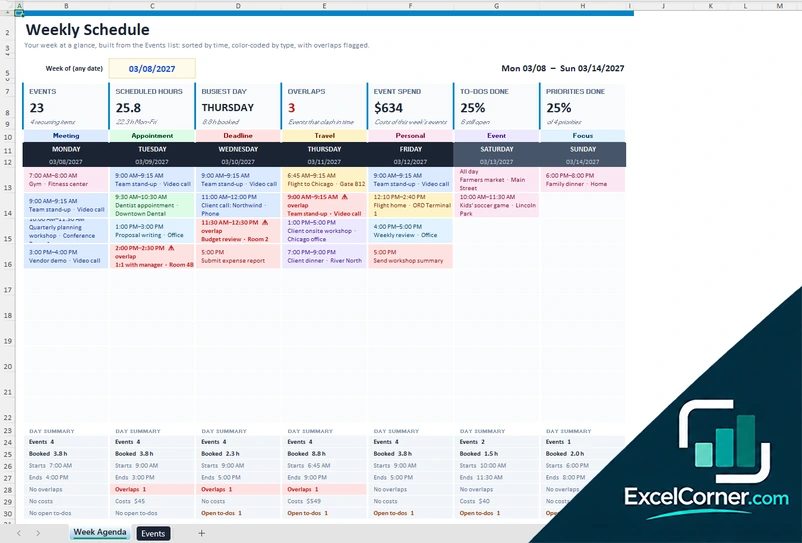
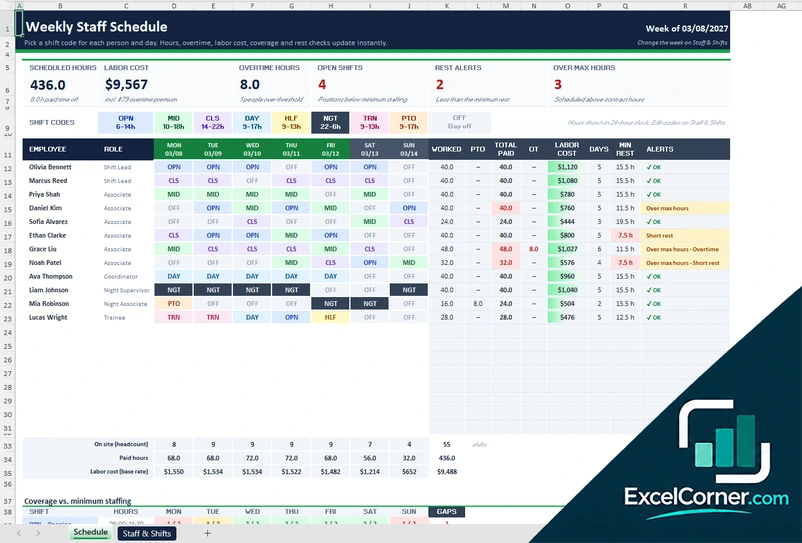
Previewing: Version 1 · Weekly Schedule Planner. Pick another version on the right.
Instant download · No sign-up · No email
Use these free Excel weekly schedule templates to plan a week. One is a personal and team weekly schedule where you add each event once and see the week at a glance, with to-dos and priorities. The other is an employee weekly schedule for shift work, with shift codes, labor cost, overtime and staffing coverage.
Choose your version
- File
- .xlsx · 71 KB · 2 sheets
- Works with
- Microsoft Excel (.xlsx)
- Macros
- None · formulas only
- Price
- Free
Make a weekly schedule in an Excel spreadsheet
A weekly schedule shows what happens on each day of the week. For an individual, it is a list of meetings, appointments and deadlines. For a business with shift work, it is who works when, how many hours that adds up to and whether every shift has enough people. A spreadsheet is a good tool for both because the week can be calculated from a list and the totals update when you make a change.
These Excel weekly schedule templates cover those two cases. The first is a weekly planner for a person or a team: you list each event once, with a repeat rule if it happens every week, and the week view fills itself, flags overlaps and adds up the scheduled hours. It also has a to-do list and a list of top priorities. The second is an employee weekly schedule for shift work, where you pick a shift code for each person and day and the workbook calculates the hours, the labor cost, the overtime, rest violations and coverage against minimum staffing.
Best for
- Individuals and teams who want one view of the week with meetings, appointments, deadlines and to-dos
- Managers of shops, restaurants, clinics and offices who schedule employee shifts
- Anyone who needs to see overlaps, workload and hours at a glance
Maybe not for
Payroll or a full workforce management system with time clocks and shift swaps. The staff schedule plans shifts and estimates the labor cost, it does not run payroll.
Which version is right for you?
Both are free, formula-driven Excel files with sample data you can replace. They are independent, so you can download both.
Version 1
Weekly Schedule Planner
Add each event once, with a repeat rule, and see the week by day with scheduled hours, overlaps, top priorities and a to-do list.
Week AgendaEvents
.xlsx · 71 KB
Version 2
Employee Weekly Schedule
Pick a shift code for each person and day and see the hours, the labor cost, the overtime, the rest alerts and the coverage.
ScheduleStaff & Shifts
.xlsx · 29 KB
What is inside the Excel weekly schedule templates
Version 1: Weekly Schedule Planner
The Events sheet has one row for each event with the date, the start time, the title, the type (meeting, appointment, deadline, travel, personal, event or focus), the location, a repeat rule and an end date for it, the cost and notes. It calculates the hours, whether the event falls in the selected week and a check for overlaps. The Week Agenda sheet shows the week of any date you enter, from Monday to Sunday, with the events for each day, a summary of each day, the number of events, the scheduled hours, the busiest day, the overlaps, the event spend, the top priorities with a status, a to-do list and a chart of the scheduled hours by day.
Version 2: Employee Weekly Schedule
The Staff & Shifts sheet holds the settings, the shift codes and the employees. You enter the week, the overtime threshold and multiplier, the minimum rest between shifts, the shift codes with their start time, unpaid break, whether the person is on site and the paid hours, such as opening, closing, office day, half day, night, training, paid time off and day off, the minimum staffing for each shift and day, and each employee with the role, team, hourly rate and maximum hours. On the Schedule sheet you pick a code for each person and day, and it shows the scheduled hours, the labor cost, the overtime hours, the open shifts, the rest alerts, the people over their maximum hours, the headcount on site and the coverage against the minimum, with two charts.
How to use a weekly schedule template in Excel
- Download
Pick the version you want and open it in Excel. The files have sample data so you can see how they work. - Pick the week
Enter any date in the week you want to plan. The schedule shows the week from Monday and recalculates when you change the date. - Set up the basics
In the weekly planner, choose the event types and the repeat rules. In the staff schedule, enter the shift codes, the employees with their hourly rate and maximum hours, the overtime rule and the minimum staffing. - Add events or shifts
Add each event once to the Events sheet, or pick a shift code for each person and day on the Schedule sheet. - Check the totals
Look at the scheduled hours, the overlaps, the labor cost, the overtime and rest alerts and the coverage, and adjust the schedule until it works.
Change the date or a shift and the week, the hours and the checks update.
Which weekly schedule template do you need?
| Weekly Schedule Planner | Employee Weekly Schedule | |
|---|---|---|
| For | Events, appointments and to-dos | Shift work and staff coverage |
| Best for | Individuals and teams planning a week | Managers who schedule employee shifts |
| Main outputs | Week view, scheduled hours, busiest day and overlaps | Hours, labor cost, overtime, rest alerts and open shifts |
| Sheets | 2 | 2 |
| Charts | Yes | Yes |
They are separate files, so you can use both.
Tips for a better weekly schedule
- Plan the week at the same time every week, for example on Friday afternoon or on Sunday evening.
- Put your most important tasks in the schedule first, then add the meetings around them.
- Leave some free time for tasks that take longer than you expect.
- For shift work, publish the schedule early, so that people can plan their own week.
- Check the minimum rest between shifts and the weekly hours before you confirm the schedule.
- Keep a copy of last week’s schedule to use as a starting point for the next.
Frequently asked questions
Is this Excel weekly schedule template free?
Yes. Both versions are free to download as .xlsx files. You do not need an account or an email address.
Which version should I choose?
Choose the Weekly Schedule Planner (Version 1) to plan your own week or a team’s week with events, to-dos and priorities. Choose the Employee Weekly Schedule (Version 2) to schedule employee shifts and check overtime, rest and coverage.
Can I schedule events that repeat every week?
Yes. In the Weekly Schedule Planner each event has a repeat rule, such as weekdays or weekly, and an end date, so a recurring meeting only has to be entered once.
How does the staff schedule calculate overtime?
You set the number of hours after which overtime starts and the overtime pay multiplier. The schedule adds up the paid hours of each employee for the week, applies the unpaid breaks and shows the overtime hours and the cost.
Does it check rest between shifts and staffing?
Yes. You set the minimum rest between shifts and the minimum number of people for each shift and day. The employee schedule flags rest alerts, people over their maximum hours and shifts that are below the minimum.
Is there a weekly agenda with times for each hour?
The Excel agenda page has a weekly agenda planner with a time grid for appointments. This page is for a week-at-a-glance schedule and for staff shifts.
Does the template work in Google Sheets?
The files are made for Microsoft Excel and use standard formulas with no macros. You can upload them to Google Drive and open them with Google Sheets, but some formatting or charts may look different.
Is my information stored online?
No. The templates are plain Excel files, so the tasks, names and dates you type stay in your own file on your own computer.
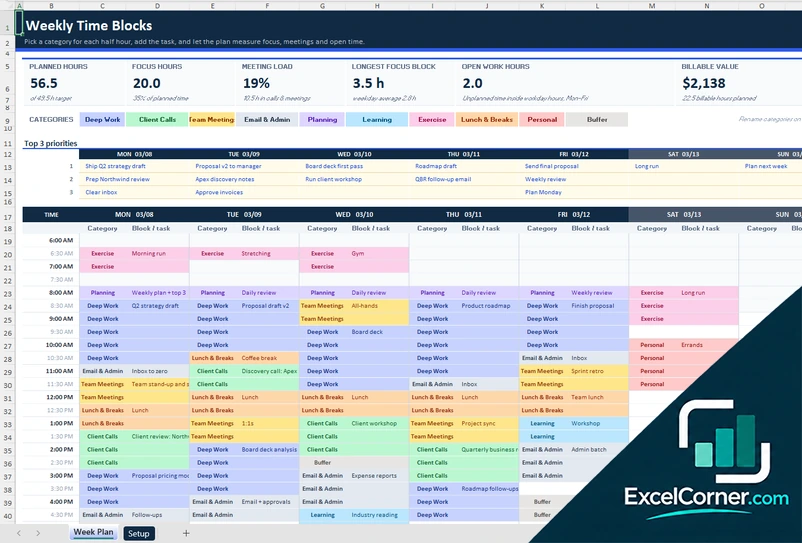
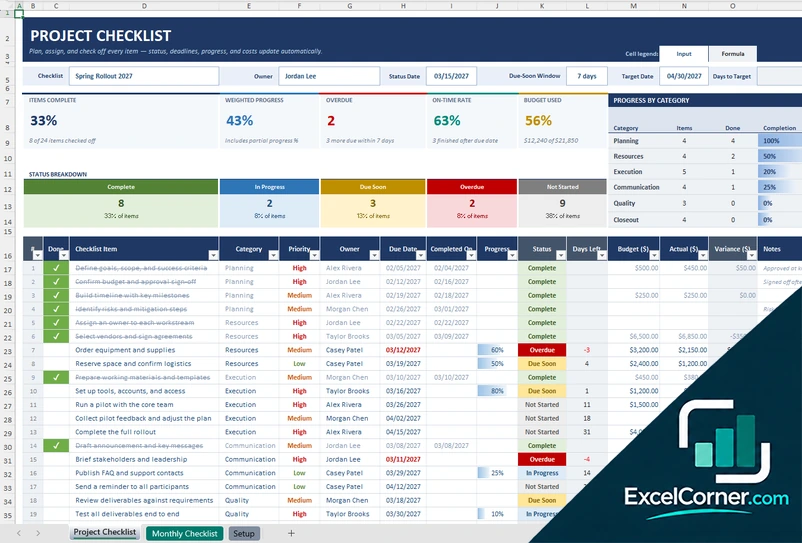
These templates are planning and record-keeping tools with sample data. Check the figures and any legal or policy requirements, such as overtime and rest rules for staff schedules, against the rules that apply to you. Excel is a trademark of Microsoft Corporation; Excel Corner is not affiliated with Microsoft.