
Home › Project Management › Project Costing Template Excel
Previewing: Version 1 · Project Costing Template. Pick another version on the right.
Instant download · No sign-up · No email
Use these free project costing templates for Excel to plan the cost of a project, track what you spend and forecast where the total will end up. One version is a full costing workbook, one tracks costs by cost code with an expense log and cash flow, and one prices a project with risk contingency, profit and a client payment schedule.
Choose your version
- File
- .xlsx · 94 KB · 4 sheets
- Works with
- Microsoft Excel (.xlsx)
- Macros
- None · formulas only
- Price
- Free
Track and control project costs in an Excel spreadsheet
Project costing answers three questions: what the work should cost, what it has cost so far, and what it will cost by the end. A spreadsheet can answer all three when the budget, the actual costs and the forecast sit in one workbook and update each other.
These project costing templates for Excel cover the main ways to do that. The first is a costing workbook with a cost plan, an actuals log and a dashboard that reports budget, actual cost, commitments, forecast at completion and cost performance. The second is a project cost tracking template built around cost codes, with an expense and commitment log, a payables view and a monthly cash flow. The third builds a cost estimate and a client price from the cost lines, with risk-based contingency, overhead, profit markup and a payment schedule.
Best for
- Project managers who need to compare budget, actual cost and forecast in one place
- Finance and PMO teams that track invoices, open purchase orders and payables for a project
- Consultants and contractors who build a cost estimate and a client price for a project
Maybe not for
Full accounting or job-cost systems with ledgers and approvals. These templates track and forecast project costs, but they do not replace your accounting software.
Which version is right for you?
All three are free, formula-driven Excel files with sample data you can replace. They are independent, so you can download more than one.
Version 1
Project Costing Template
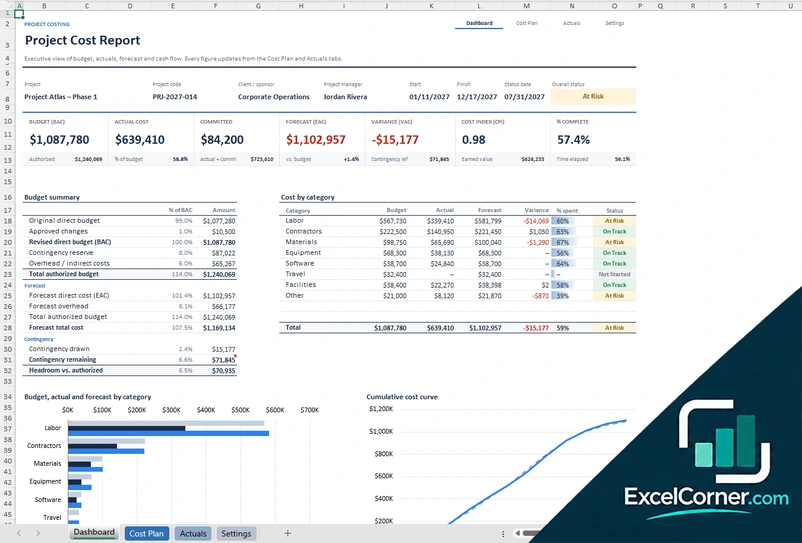
Plan the cost of each line, log actuals and commitments, and report budget, forecast at completion, variance and cost performance on a dashboard.
DashboardCost PlanActualsSettings
.xlsx · 94 KB
Version 2
Project Cost Tracker
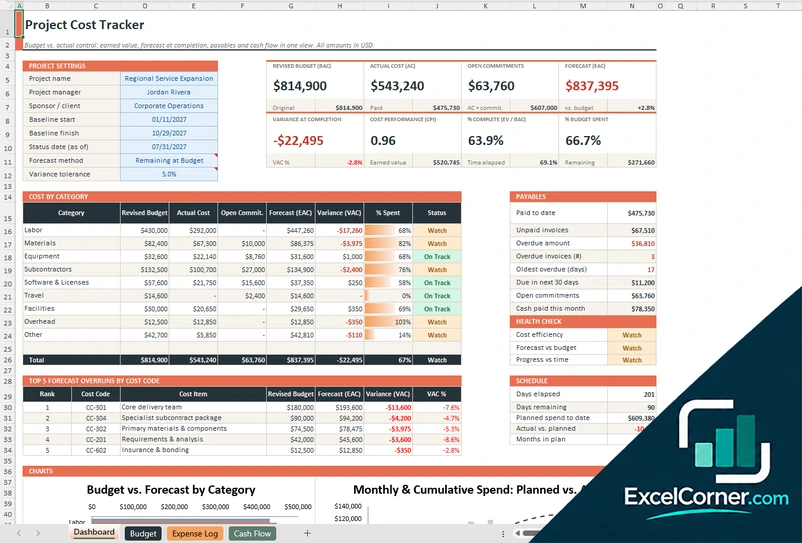
Track budget against actual cost by cost code, with an expense and commitment log, a payables view and a monthly cash flow.
DashboardBudgetExpense LogCash Flow
.xlsx · 78 KB
Version 3
Project Cost Estimate and Pricing Workbook
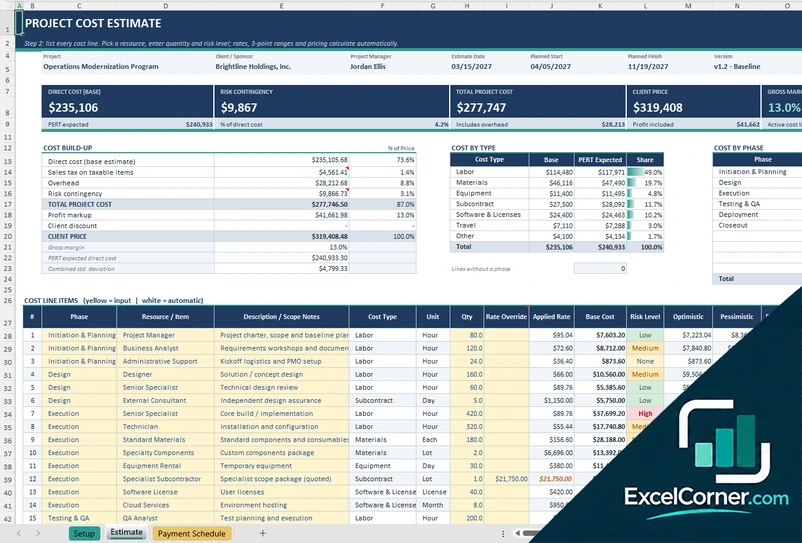
Build a cost estimate from resource lines, add risk contingency, overhead and profit to get a client price, and plan the billing schedule.
SetupEstimatePayment Schedule
.xlsx · 41 KB
What is inside the project costing Excel templates
Version 1: Project Costing Template
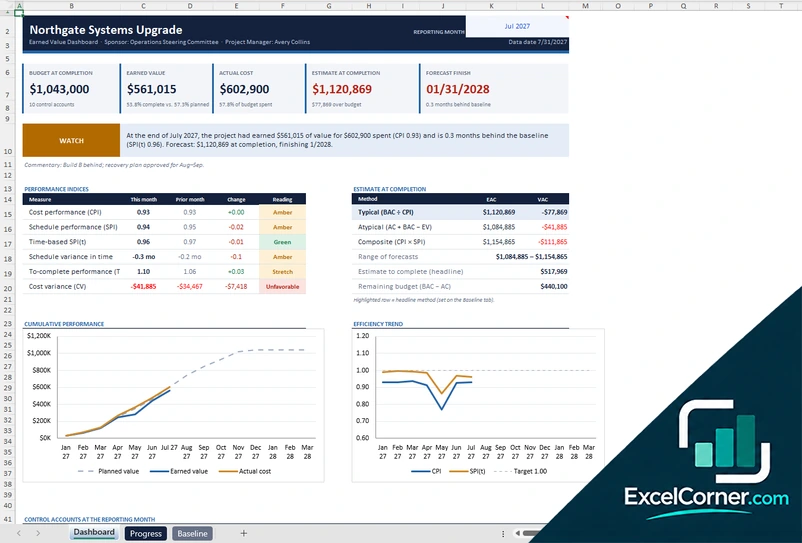
The Settings sheet holds the project details, the contingency reserve, the overhead rate, the variance tolerance, the forecast method and the lists of phases, categories and payment terms. The Cost Plan lists every cost line with its original budget, approved changes, committed amount, actual cost, percent complete and schedule, and calculates the earned value, the forecast, the variance and the monthly phasing. The Actuals sheet logs invoices, expenses and purchase orders with payment terms and shows what is paid, unpaid, overdue and due in the next 30 days. The Dashboard reports the budget, actual cost, committed amount, forecast, variance, cost index and percent complete, with a budget summary, cost by category and two charts.
Version 2: Project Cost Tracker
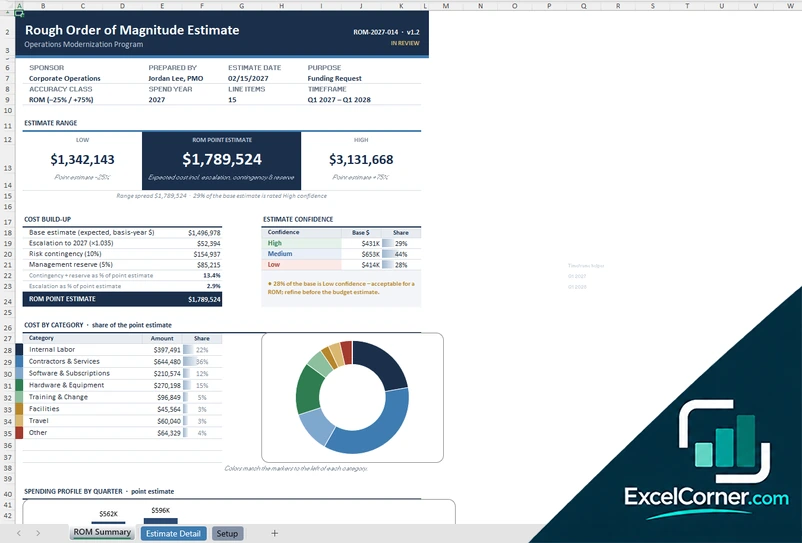
The Budget sheet sets the budget by cost code with the workstream, category, owner and planned dates, plus approved changes, actual cost, open commitments, percent complete and the forecast at completion. The Expense Log records every invoice, expense and purchase order with the vendor, reference, payment terms, due date and paid date. The Cash Flow sheet phases the planned spend across a 12-month window and compares it with actual cost and cash paid out. The Dashboard shows the budget, actual cost, commitments, forecast and cost performance, the cost by category, a payables panel, a health check, the five largest forecast overruns and two charts.
Version 3: Project Cost Estimate and Pricing Workbook
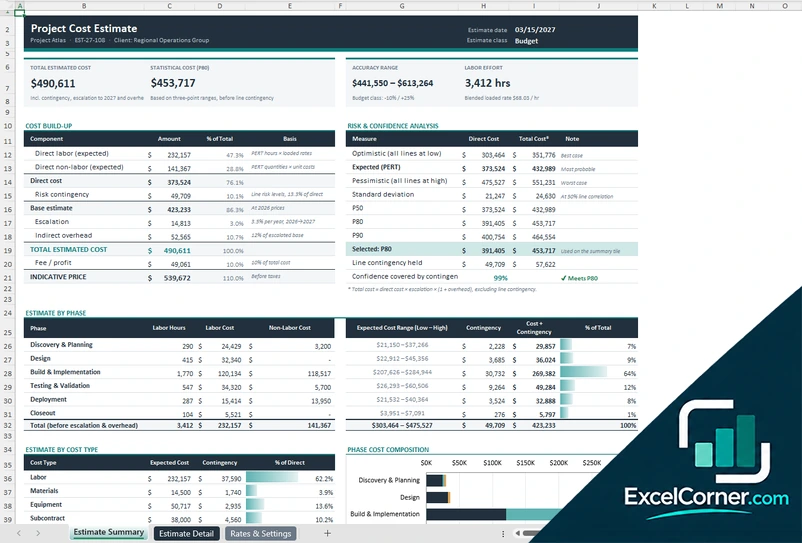
The Setup sheet holds the project information, the pricing rules and the risk profiles. You set the overhead rate, the profit markup, the sales tax on taxable items, the client discount, the contingency method and the target confidence level. On the Estimate sheet you list every cost line with the phase, the resource, the cost type, the quantity and the risk level, and the workbook calculates the base cost and the PERT expected cost from the three-point ranges. It adds the contingency, overhead and profit to give the total project cost, the client price and the gross margin, with the cost by type and by phase. The Payment Schedule builds the installments for a payment plan and tracks the amounts billed, received, outstanding and overdue.
How to use a project costing template in Excel
- Download
Pick the version you want and open it in Excel. Each file has sample data so you can see how the sheets work. - Enter the project details
Fill in the project name, the dates, the status date and the rules on the Settings or Setup sheet: contingency, overhead, forecast method and the lists of phases and categories. - Set the budget
List every cost line with its category, owner and budget. In the tracking and costing versions, add approved changes as they happen. - Log the costs
Record invoices, expenses and open purchase orders with their dates and payment terms, or, in the estimate version, set the quantities and rates. - Read the results
Check the dashboard for budget, actual cost, forecast at completion, variance and cost performance, and update the status date each reporting period.
Update the status date and the actuals each period, and the forecast and the charts recalculate.
Which project costing template do you need?
| Project Costing Template | Project Cost Tracker | Cost Estimate and Pricing Workbook | |
|---|---|---|---|
| For | A budget, actuals and forecast report | Cost codes, expenses and cash flow | Estimating and pricing a project |
| Best for | Project managers reporting cost performance | Teams that track payables and monthly spend | Contractors and consultants quoting a price |
| Main outputs | Budget, actual, committed, forecast, variance and cost index | Forecast by cost code, payables and planned vs. actual spend | Total cost, client price, margin and payment schedule |
| Sheets | 4 | 4 | 3 |
| Charts | Yes | Yes | No |
They are separate files, so you can use more than one.
Tips for tracking project costs
- Set the budget by cost line before the project starts, and record approved changes separately so you can see the original budget and the revised one.
- Track open commitments, such as purchase orders, as well as invoices. They show money that is already spoken for.
- Update the status date and the percent complete each period, since the earned value and the forecast depend on them.
- Choose a forecast method that fits the project. Assuming the rest of the work costs what was budgeted is simple, while a cost-performance forecast is more cautious when you are over budget.
- Review overdue invoices and payables every month so cash flow does not surprise you.
- Keep one file per project, so the totals and the charts always refer to the same work.
Frequently asked questions
Are these project costing templates for Excel free?
Yes. All three versions are free to download as .xlsx files. You do not need an account or an email address.
Which version should I choose?
Choose the Project Costing Template (Version 1) to report budget, actual cost and forecast in a dashboard. Choose the Project Cost Tracker (Version 2) to track costs by cost code with an expense log, payables and a monthly cash flow. Choose the Cost Estimate and Pricing Workbook (Version 3) to build a cost estimate and a client price.
How does the forecast at completion work?
The forecast adds the actual cost and the open commitments to an estimate of the remaining cost. On the settings sheet you choose the forecast method, for example remaining work at budget or adjusted by the cost performance index.
What is the cost performance index?
The cost performance index, or CPI, is the earned value divided by the actual cost. A value below 1.00 means the project is spending more than the work completed is worth.
Can I track invoices and payment dates?
Yes. The costing and tracking versions have a log for invoices, expenses and purchase orders with payment terms, due dates, paid dates, status and days overdue. The estimate version has a client payment schedule with billing, receipts and overdue amounts.
Does the project costing template include charts?
Versions 1 and 2 include charts of budget, actual and forecast by category and of spend over time. Version 3 is a table-based estimate with no charts.
Does the template work in Google Sheets?
The files are made for Microsoft Excel and use standard formulas with no macros. You can upload them to Google Drive and open them with Google Sheets, but some formatting or charts may look different.
Is my project information stored online?
No. The templates are plain Excel files, so the costs, names and dates you type stay in your own file on your own computer.
More free project management templates
These templates are planning and record-keeping tools with sample data. Check the figures against your contracts, invoices and accounting records before you rely on them. Excel is a trademark of Microsoft Corporation; Excel Corner is not affiliated with Microsoft.